


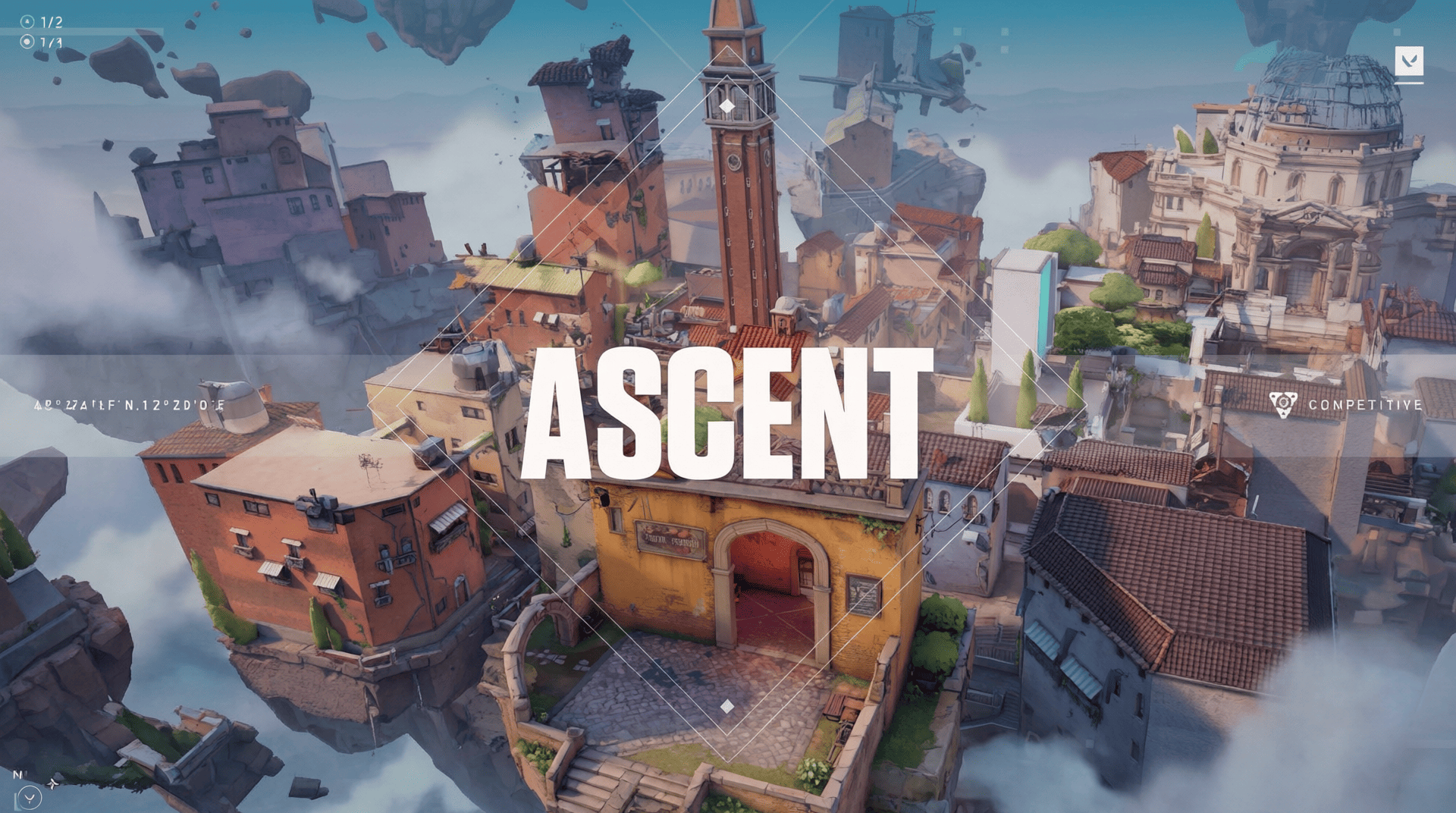
Ascent is a two site map set in Venice, Italy, on Alpha Earth. It is built around a wide open Mid that connects the two Spike Sites and gives attackers additional routes into both sides of the map. Ascent also has one mechanical door at each site. The doors can be closed from switches on the defender side, have 500 HP while closed, and remain permanently open after being destroyed.
Ascent returned to the Competitive map pool with Patch 12.08 on April 28, 2026. It remained in the pool when Patch 13.00 introduced Summit in June, and it was still in the active rotation after Patch 13.04 replaced Breeze with Abyss in August 2026.
If you want to climb ranked faster, a Valorant boost can help you progress while you work on map specific mechanics, positioning, and communication.
From this guide, you will learn:
- Map Overview
- Callouts
- Best Agents for Ascent
- Map Rotation Status
- Ascent Changes
- Where Ascent Is Located & When It Was Added
- How to Play Ascent
- Advanced Strategies
Ascent Map Overview
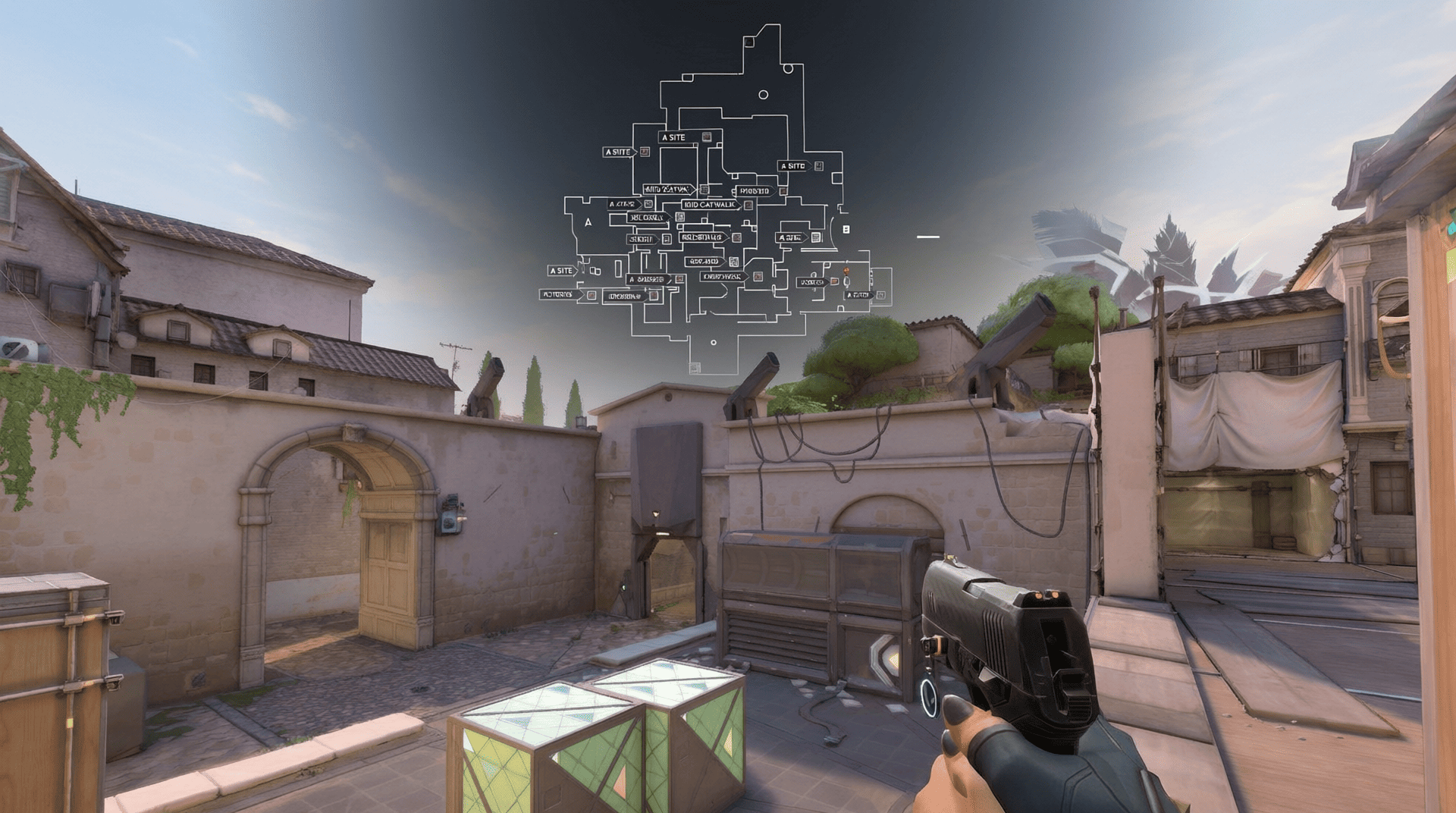
Ascent is a traditional three lane map with two Spike Sites and a large open Mid. Riot designed Ascent as a baseline tactical experience built around clear sightlines, conventional lane structure, and a mechanical door system that allows defenders to alter access to each site.
Attackers can approach A through A Main or the Mid routes leading toward Tree. B can be approached through B Main or through Market from Mid. This makes Mid control important because it creates additional paths toward both sites instead of forcing attackers to commit to one main entrance.


Ascent was one of the first maps developed for VALORANT. Riot says the team used Ascent to develop and refine much of the game’s core map design, with the map remaining in greybox development for close to three years.
Valorant Ascent Callouts
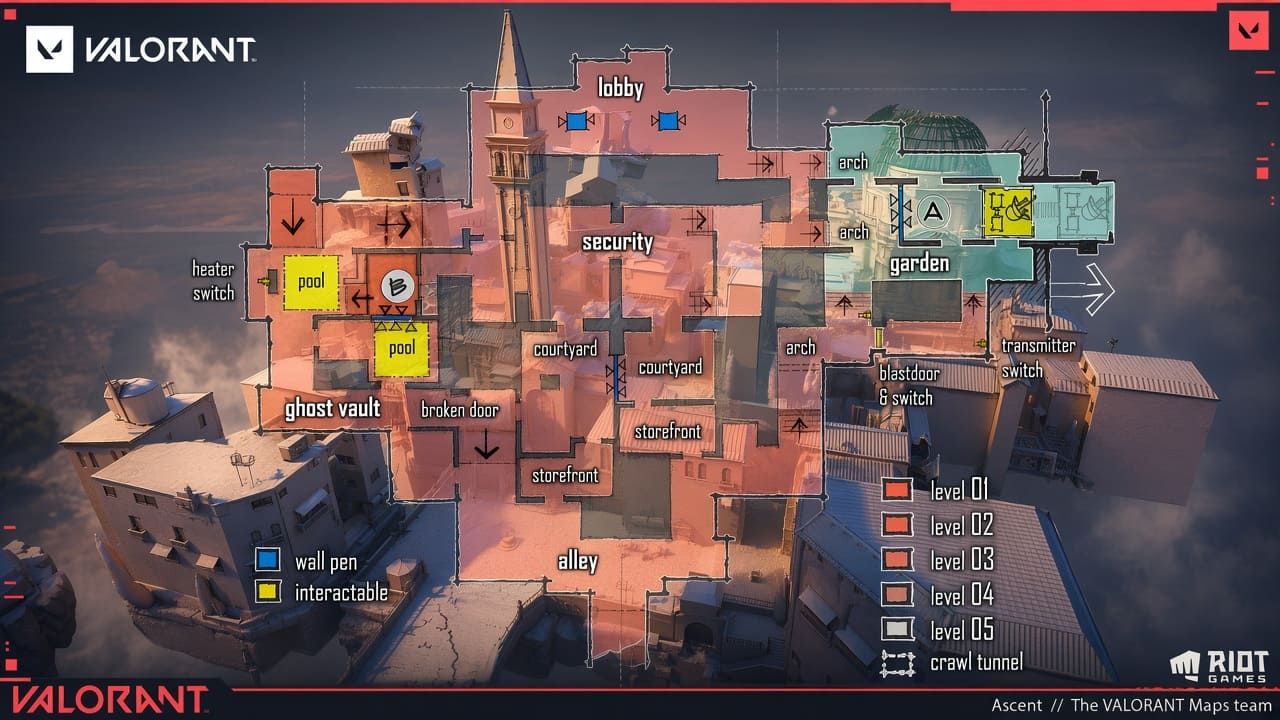
Ascent has 22 standard callouts across A Site, Mid, B Site, Attacker Side Spawn, and Defender Side Spawn. The standard map callouts include Tree, Lobby, Main, Window, Site, Garden, Rafters, Wine, Bottom, Catwalk, Cubby, Market, Courtyard, Link, Pizza, Top, Boat House, and both team spawns.
| Zone | Official Callouts | Common Terms |
|---|---|---|
| A Site | Tree, Lobby, Main, Window, Site, Garden, Rafters, Wine | Heaven, Hell, Generator |
| Mid | Bottom, Catwalk, Cubby, Market, Courtyard, Link, Pizza, Top | Cat, Tiles, Arch |
| B Site | Lobby, Main, Boat House, Site | Logs, Default, Back Site |
| Spawns | Attacker Side Spawn, Defender Side Spawn | Attacker Spawn, Defender Spawn, CT |
A Site Callouts Explained
- A Main is the primary attacker route toward A Site.
- A Lobby is the staging area before A Main.
- Tree connects the Mid area with the short route toward A Site.
- Garden is the area between A Main and A Site near Window.
- Window is the breakable glass opening overlooking Garden.
- Wine is the recessed area in A Main.
- Rafters is the elevated position overlooking A Site.
- Site refers to the plant area itself.
Mid Callouts Explained
- Catwalk is the elevated route from Mid toward Tree.
- Market is the building connecting Mid with B Site and contains the B mechanical door.
- Courtyard is the central open area of Mid.
- Pizza is the small area near the Defender Side Spawn side of Mid.
- Top and Bottom describe the upper and lower areas of Mid.
- Link is one of the connecting routes around the center of the map.
- Cubby is a small recessed position in Mid.
B Site Callouts Explained
- B Main is the primary attacker entrance to B Site.
- B Lobby is the staging area outside B Main.
- Boat House is the enclosed structure on B Site that provides cover and defensive positions.
- B Site is the plant area on the B side of the map.

Best Agents for Ascent
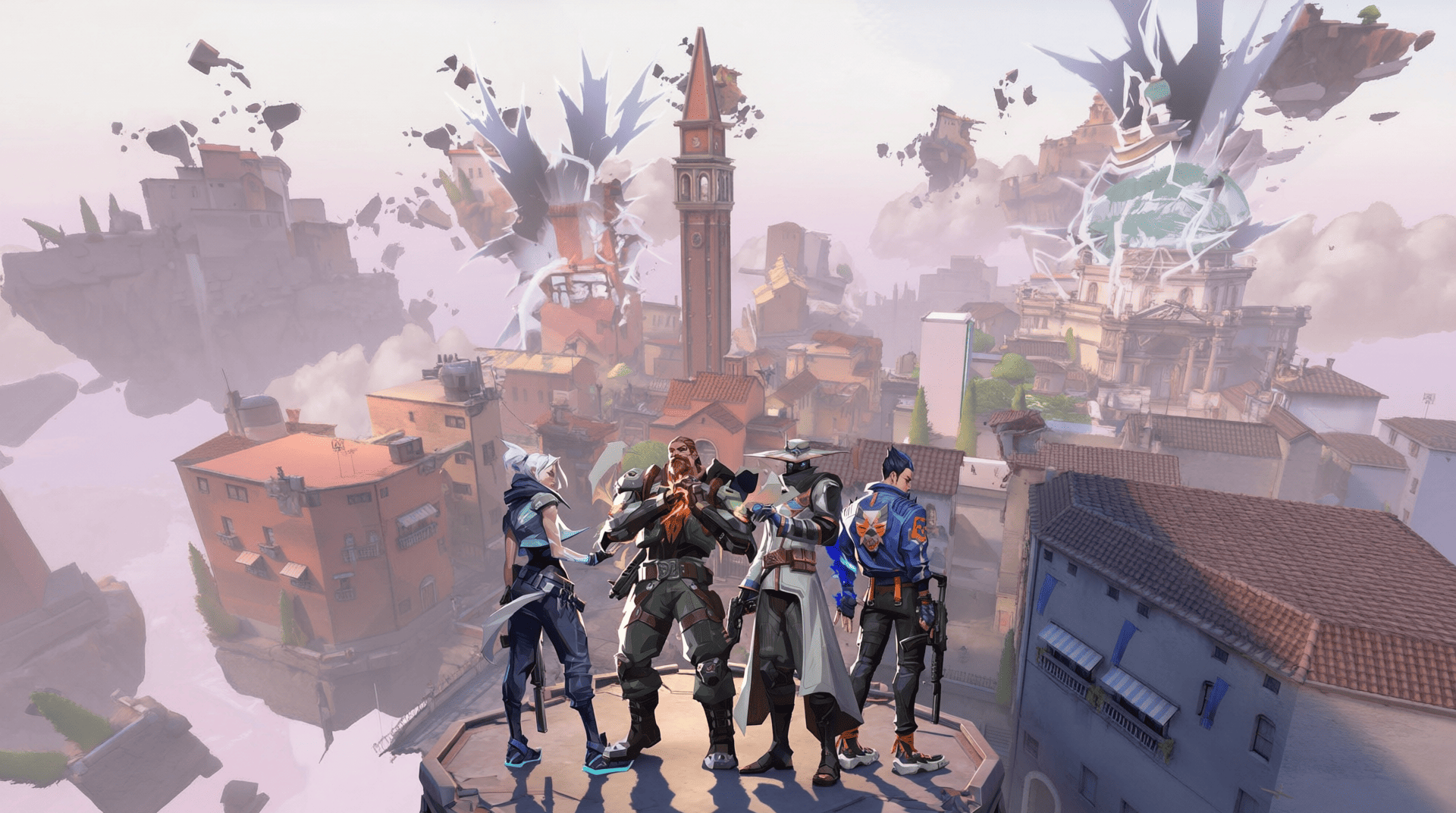
Ascent rewards agents that can contest Mid, gather information, and control narrow entrances. There is no single mandatory composition, but several agents naturally interact well with the map’s long lanes, two site entrances, and controllable doors.
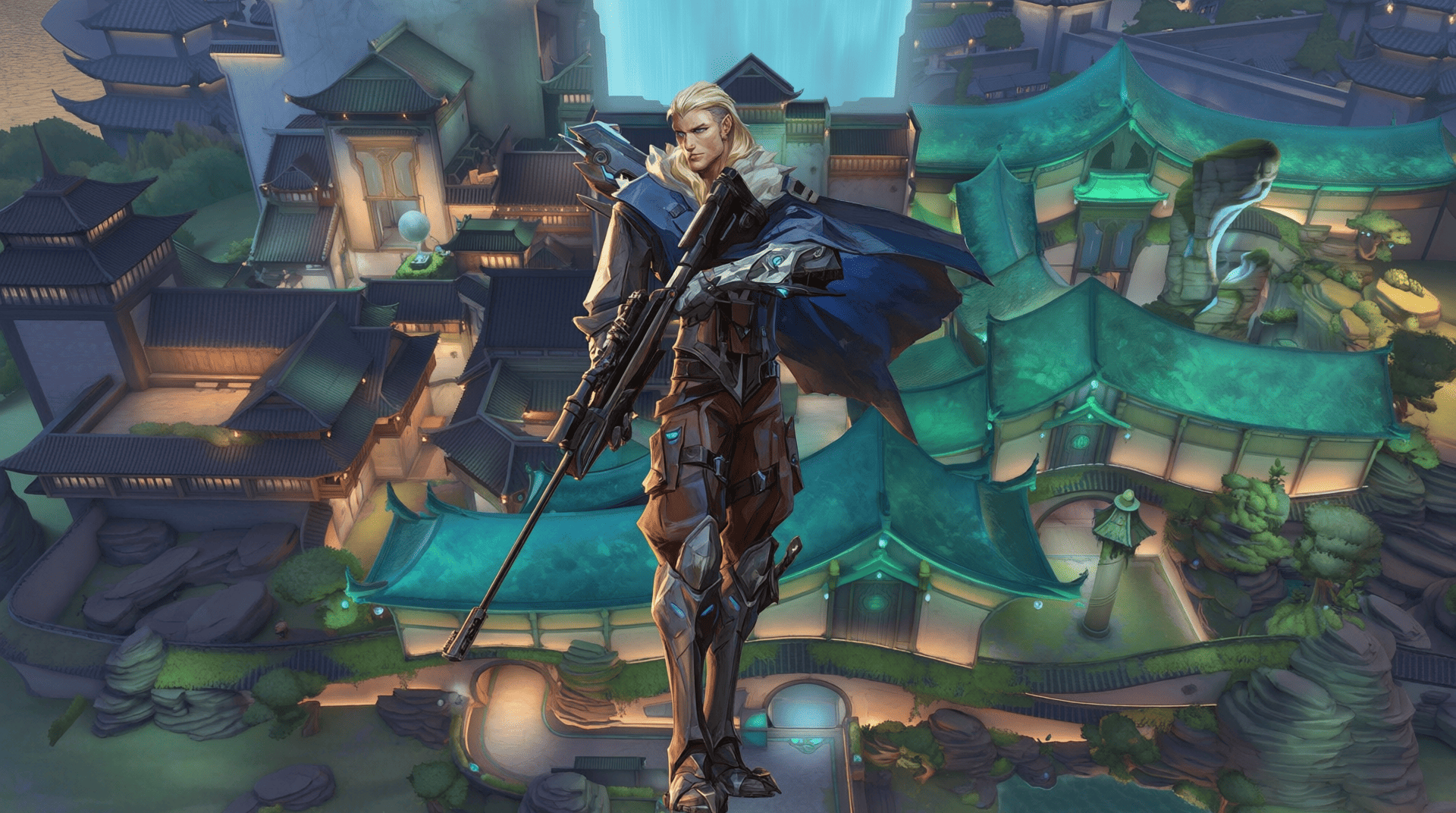
Sova fits Ascent because Recon Bolt and Owl Drone can gather information through predictable lanes and help teams clear positions before entering A or B. His utility is especially useful when a team wants to contest Mid before committing to a site.
Killjoy works well as a site anchor because Turret, Alarmbot, and Nanoswarm can cover entrances while allowing the player to reposition.
Omen provides flexible smokes for Mid, Market, Tree, and site entrances. His teleport can also create additional options around the map’s vertical positions.
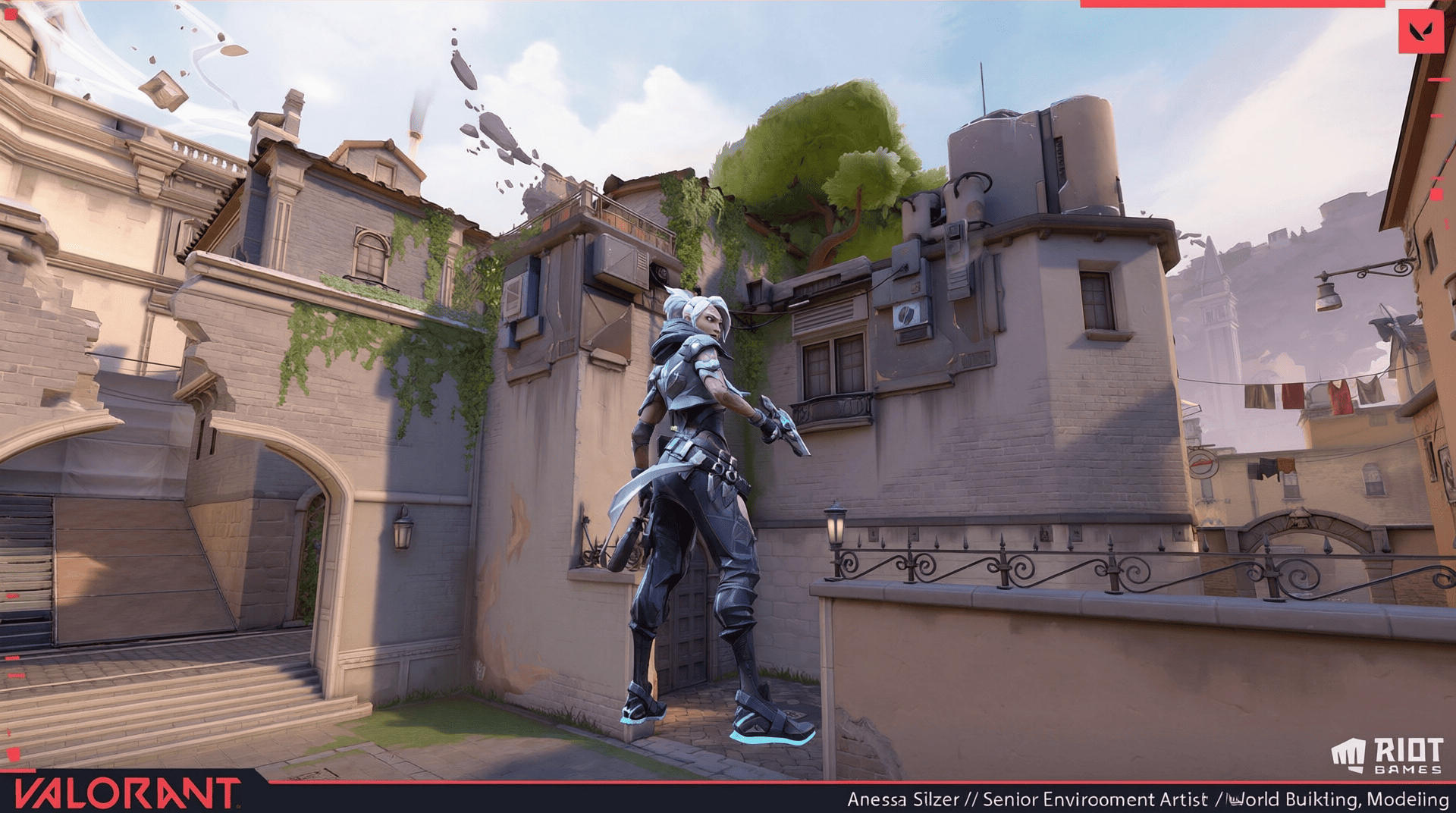
Jett benefits from Ascent’s long sightlines and elevated positions. Tailwind allows Jett to take aggressive Operator angles and disengage after creating space. Jett’s interaction with the A Window was also changed in Patch 9.08, allowing Tailwind to break through the window instead of stopping at it.
KAY/O can support structured site executions with ZERO/POINT suppression and FLASH/DRIVE. His utility is useful when defenders rely heavily on layered defensive abilities around an entrance.
Agents to consider together: Sova and Killjoy provide information and defensive control, while Omen, Jett, and KAY/O can help a team contest Mid and convert that space into a site execution.
Is Ascent in the Current Valorant Map Pool?
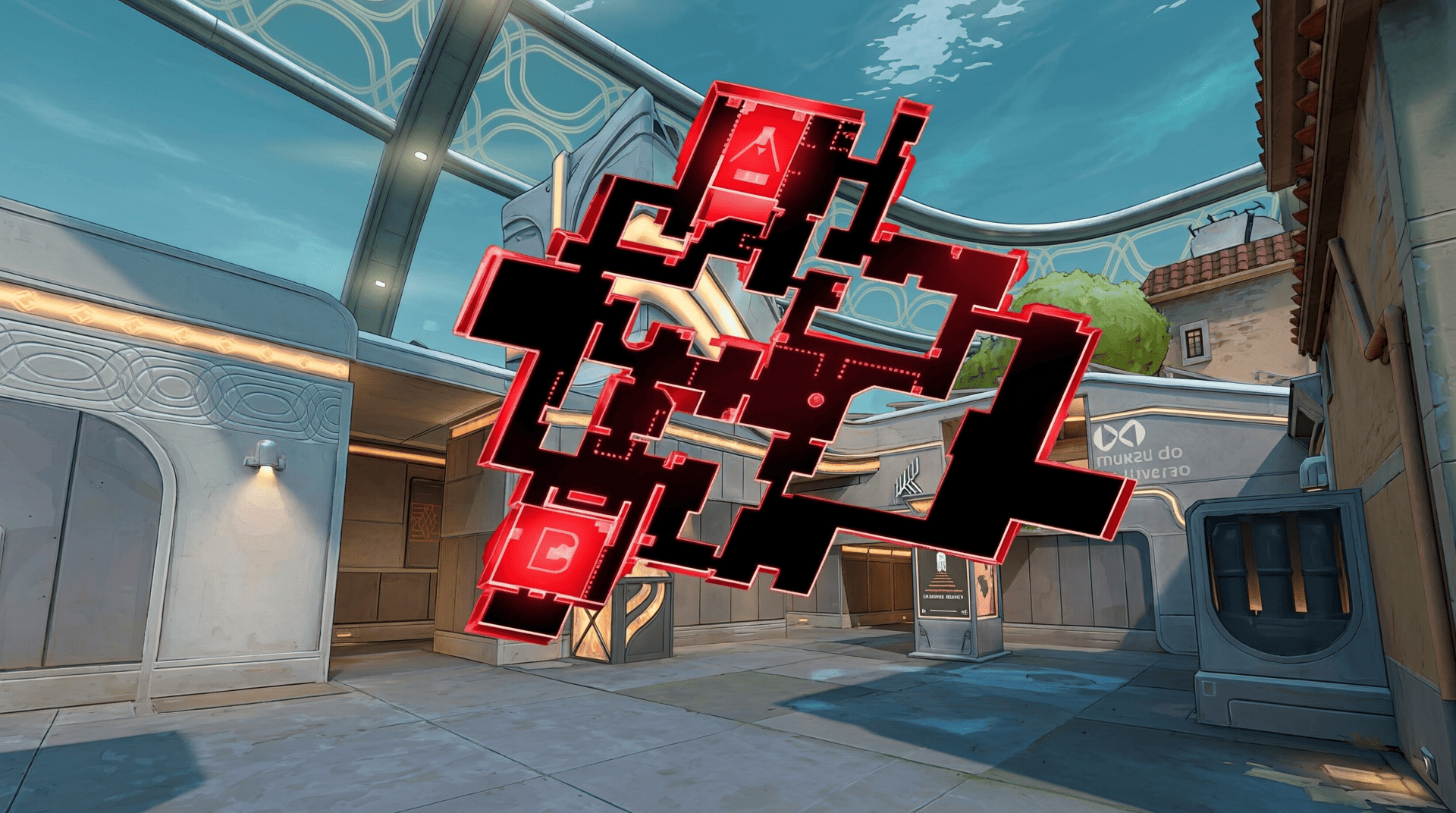


Maps outside the Competitive rotation remain available in other supported game modes. Rotation changes are announced through Riot’s patch notes rather than representing a permanent removal of a map from VALORANT.
Valorant Ascent Changes
- Patch 13.00, June 2026: Ascent remained in the Competitive and Deathmatch pool while Summit entered and Fracture and Pearl left. Riot also made broader Sentinel and Initiator changes that affected agents commonly used on Ascent.
- Patch 12.08, April 2026: Ascent returned to Competitive and Deathmatch, while Bind left the rotation. No direct geometry change to Ascent was listed in the patch.
- Patch 11.08, October 2025: Ascent left the Competitive and Deathmatch queues and was replaced in the rotation by other maps.
- Patch 10.04, March 2025: Riot changed part of the B Main wall along B Lane to make it non penetrable. The stated goal was to give attackers more safety when approaching B Main after the barriers dropped.
- Patch 9.08, October 2024: Jett’s Tailwind and Skye’s Trailblazer began breaking through the A Window instead of stopping at the glass.
- Patch 9.06, September 2024: Riot changed how several abilities interact with Ascent’s glass window. Phoenix’s Blaze and Neon’s Fast Lane can break the window when the initial cast center point hits it, while Harbor’s High Tide no longer breaks the glass.
- Patch 4.04, March 2022: The B Orb could be collected from the lower box, removing the previous need for a double jump to reach it.
- Patch 3.06, September 2021: One crate on A Site was changed so that it could no longer be penetrated by bullets.
- Patch 2.09, May 2021: Riot fixed an issue that could trap players between Sage’s Barrier Orb and the mechanical doors on Ascent.
Where Is Ascent Located & When Was It Added?

Ascent’s location is associated with San Marco in Venice. The map’s visual design uses recognizable Venetian architecture and landmarks, while the playable area is presented as a floating section of the city rather than a normal street level location.
Ascent was added to VALORANT on June 2, 2020. The map launched with Patch 1.0. Riot’s development retrospective describes Ascent as one of the first maps built for VALORANT and explains that its development helped establish the game’s traditional three lane map structure.
The map was designed around a traditional tactical layout with two Spike Sites and an open Mid. Riot specifically describes the goal as creating a baseline map where players could fight for territory while using mechanical doors to alter connections between areas.
How to Play Ascent
The most reliable way to approach Ascent is to treat Mid as a contested resource rather than automatically committing to it every round. Controlling Mid can open routes toward Tree and Market, but the timing and amount of utility used should depend on the information your team gets from the first engagements.
Attack Strategy
1. Contest Mid with a clear purpose. A Mid take is useful when it gives the team access to Tree, Market, or a rotation behind the defenders. Avoid spending the entire attacking utility budget on Mid if the team already has enough information to execute through A Main or B Main.
2. Use the doors as timing tools. The A Link and Market doors can delay a push and force attackers to spend time and ammunition destroying them. Once a door is destroyed, it stays open for the rest of the round, so breaking it early can permanently change the route between areas.
3. Clear elevated A positions. Rafters and the positions around Heaven give defenders strong vision over A Site. Attackers should account for these angles before committing to a plant.
4. Respect B Main wallbang angles. Patch 10.04 made part of the B Main wall non penetrable, so older lineups and spam patterns may not work across every section of the wall.
5. Keep a route for the post plant. A successful plant is easier to defend when attackers retain control of at least one useful approach route. Mid, Tree, Market, and the main entrances should be treated as connected parts of the post plant rather than isolated positions.
Defense Strategy
1. Contest Mid without overcommitting. Mid provides access to both sides of the map, so defenders need information about the early attack while keeping enough players available to defend the sites.
2. Use the doors before the hit arrives. Closing a door can buy time and force attackers to reveal their presence by damaging it. The door is not permanent cover because it has 500 HP and can be destroyed.
3. Combine information with utility. Agents such as Sova and Killjoy can gather or maintain information while other defenders hold the main entrances. The goal is to delay the attack until rotations arrive rather than fight every angle at once.
4. Treat the destructible Mid panels as part of the round. The 400 HP panels can be removed to create different wallbang and sightline possibilities. Their state should be considered when deciding whether Mid remains safe to contest.
Ascent Pro Tips & Advanced Strategies
1. Learn the Mid relationships first. Catwalk, Courtyard, Market, Pizza, Link, and Tree are easier to understand as a connected system than as isolated callouts. The important question is always which route your Mid control opens next.
2. Do not destroy every door immediately. A closed door can temporarily restrict information and movement. Attackers should decide whether breaking it creates a meaningful route before spending ammunition and revealing the timing of the play.
3. Track the A Window. The glass window is destructible, and several abilities interact with it in specific ways. Patch 9.06 and Patch 9.08 changed several of those interactions, so older lineups may behave differently from current versions.
4. Use the Mid panels deliberately. The 400 HP destructible panels are not simply decorative objects. Their destruction changes how players can use the surrounding walls and sightlines.
5. Do not confuse community callouts with standard map names. Terms such as Heaven, Hell, Generator, Tiles, Arch, and CT are commonly heard in ranked communication, while the standard map callouts include Rafters, Tree, Market, Courtyard, Link, Pizza, and the other locations shown in the map callout system.
6. Ascent rewards disciplined rotations. The open Mid makes information valuable because control of the center can expose whether defenders can rotate between A and B safely. Attackers should use that information to decide whether to continue the original plan or change the point of attack.
7. Learn A Main, Tree, Catwalk, Market, B Main, and Boat House early. These locations cover the most important connections between the two sites and Mid, giving new players a practical foundation before they memorize smaller positions.
8. Remember the original design goal. Riot built Ascent as a traditional three lane tactical map with a mechanical door system. Understanding that structure explains why Mid control, site entrances, doors, and rotation timing are so central to the map.
FAQ
Is Ascent in the current Valorant map pool?
Yes. Ascent returned to Competitive and Deathmatch with Patch 12.08 on April 28, 2026. It remained in the rotation after Patch 13.00 added Summit and after Patch 13.04 replaced Breeze with Abyss.
How much HP do the doors on Ascent have?
Each closed mechanical door has 500 HP. The doors are impenetrable while closed, but they can be damaged and destroyed. Once destroyed, the doorway remains open for the rest of the round.
How many destructible panels are on Ascent?
Ascent has two destructible panels in Mid. Each panel has 400 HP. While intact, the panels absorb damage and cannot be penetrated by gunfire.
Does the glass window on Ascent break?
Yes. The A Window glass is destructible. Riot has changed how several abilities interact with the window, including Phoenix’s Blaze, Neon’s Fast Lane, Harbor’s High Tide, Jett’s Tailwind, and Skye’s Trailblazer.
What is the most important area on Ascent?
Mid is the central strategic area of Ascent. Controlling Mid can provide access toward Tree and Market and can create additional routes toward both Spike Sites.
What are the main callouts on Ascent?
The standard callouts include Tree, Lobby, Main, Window, Site, Garden, Rafters, Wine, Bottom, Catwalk, Cubby, Market, Courtyard, Link, Pizza, Top, Boat House, and both team spawns. Community terms such as Heaven, Hell, Generator, Arch, and CT are also commonly used in ranked communication.
When was Ascent added to Valorant?
Ascent was added on June 2, 2020, with VALORANT Patch 1.0. Riot describes Ascent as one of the first maps developed for the game and says its development helped establish the traditional three lane map structure used by VALORANT.
Where is Ascent located?
Ascent is located in Venice, Italy, on Alpha Earth. The map represents a floating section of Venice created after the Radianite related disaster depicted in the early VALORANT story.
What changed on Ascent in Patch 10.04?
Riot changed part of the B Main wall along B Lane to non penetrable. The change was intended to give attackers more safety when approaching B Main after the barriers dropped.
Which agents work well on Ascent?
Sova, Killjoy, Omen, Jett, and KAY/O all have tools that fit Ascent’s layout. Sova provides information, Killjoy can anchor sites, Omen controls long sightlines with smokes, Jett benefits from elevated and long range angles, and KAY/O can suppress defensive utility during executions.
How many maps are currently in the Valorant Competitive pool?
The active Competitive pool has seven maps. As of September 2026, those maps are Ascent, Abyss, Haven, Lotus, Split, Summit, and Sunset. Patch 13.04 moved Abyss into the rotation and removed Breeze, while Patch 13.00 had added Summit and removed Fracture and Pearl.








Comments: